Motherboard form factor case fit, from Mini-ITX to E-ATX

Motherboard sizes nest because six of nine micro-ATX screw holes sit on ATX positions, per Intel’s spec. Back-connect boards need a case cut for them.
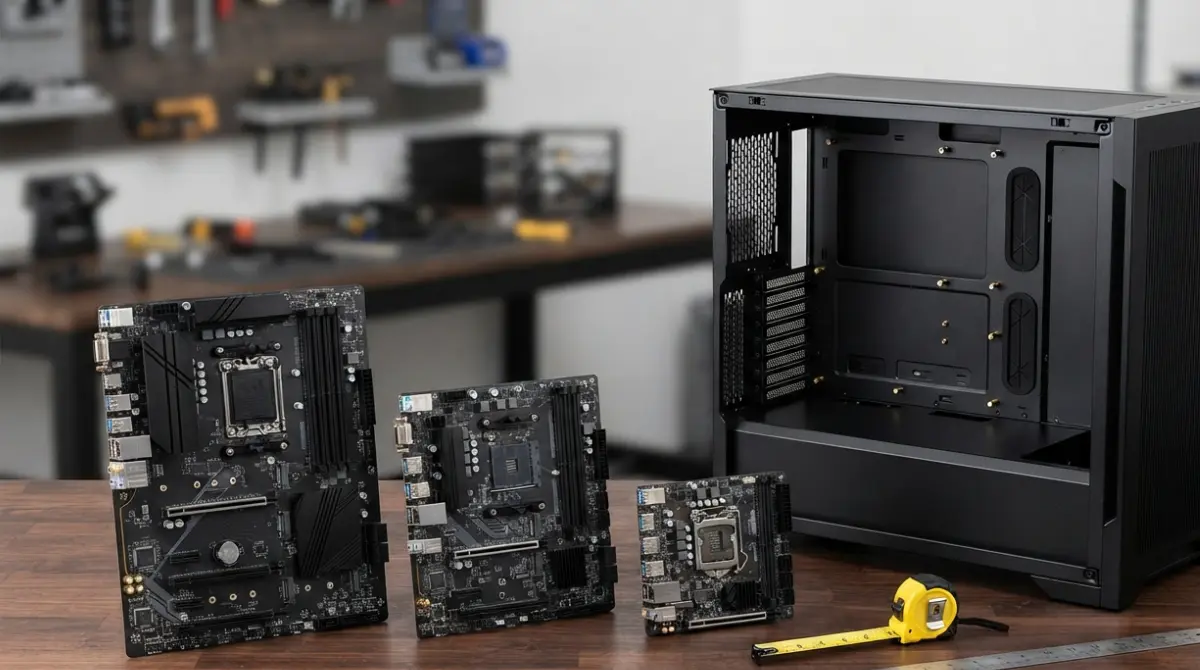
Table of Contents
A case takes every motherboard size named on its support line. The three standard sizes nest inside each other: Mini-ITX and micro-ATX boards fit ATX cases because Intel put their screw holes on ATX positions. Two kinds of board break that pattern. E-ATX boards have to be matched to the case in millimeters, and back-connect boards need a case built with cutouts for them.
Form factor is one of five checks in the full motherboard compatibility checklist, along with socket, BIOS version, lane sharing and clearance.
Board sizes and the cases that take them
A full ATX board is 305 × 244 mm (12 × 9.6 in), and Intel defines the smaller sizes against it. This table puts the board size, slot limit and mounting-hole letters from Intel’s documents side by side.
| Form factor | Largest board | Expansion slots | Intel hole positions |
|---|---|---|---|
| ATX | 305 × 244 mm (12 × 9.6 in) | Up to 7 | A, C, F, G, H, J, K, L, M |
| micro-ATX | 244 × 244 mm (9.6 × 9.6 in) | Up to 4 | B, C, F, H, J, L, M, R, S |
| Mini-ITX | 170 × 170 mm (6.7 × 6.7 in) | 1 | C, F, H, J |
Sources: Intel ATX Specification 2.2 for the ATX and micro-ATX sizes, slots and holes; Intel Mini-ITX Addendum 2.0 for Mini-ITX.
All four Mini-ITX holes are also ATX and micro-ATX holes. Six of the nine micro-ATX holes (C, F, H, J, L and M) are ATX holes too. That overlap is why a smaller board drops into a bigger case.
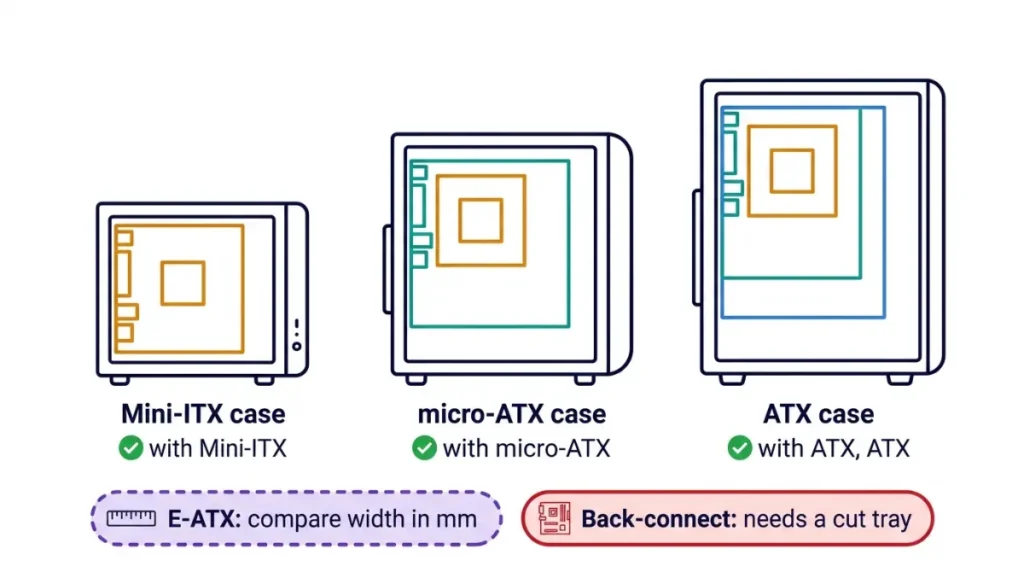
It doesn’t work the other way. An ATX board is 61 mm longer than the largest micro-ATX board, so a case that lists only micro-ATX or Mini-ITX has neither the room nor the standoff positions G, K and A that an ATX board screws into.
Will a micro-ATX board fit an ATX case?
Yes, when the case lists micro-ATX on its support line. Intel’s ATX specification says the ATX size lets many ATX cases accept micro-ATX boards. The word is “many,” not “all,” so the support line still decides.
ATX doesn’t use three of the micro-ATX holes: B, R and S. Intel dropped B from ATX and says a case that adds it should use a removable standoff. R and S were added for micro-ATX and sit toward the board’s front edge.
ASRock’s support answer for combined ATX and micro-ATX cases gives the order. Fit standoffs at B, C, F, H, J, L and M first. Then check whether your own board has holes at R and S before fitting those two.
The ports end up in the same place with either size. ATX defines one rear I/O opening of 158.75 × 44.45 mm (6.25 × 1.75 in), and Intel’s drawing shows the same 6.25-inch shield width for both ATX and micro-ATX.
Stop if: a standoff sits under your board where there is no screw hole. Intel’s ATX spec keeps the underside of the board free of components only in a small square around each required mounting hole, so a stray standoff can press against circuitry. Take it out before you lower the board.
For the order in which the I/O shield, standoffs and board go in, see motherboard standoffs installation order.
E-ATX widths against named case limits
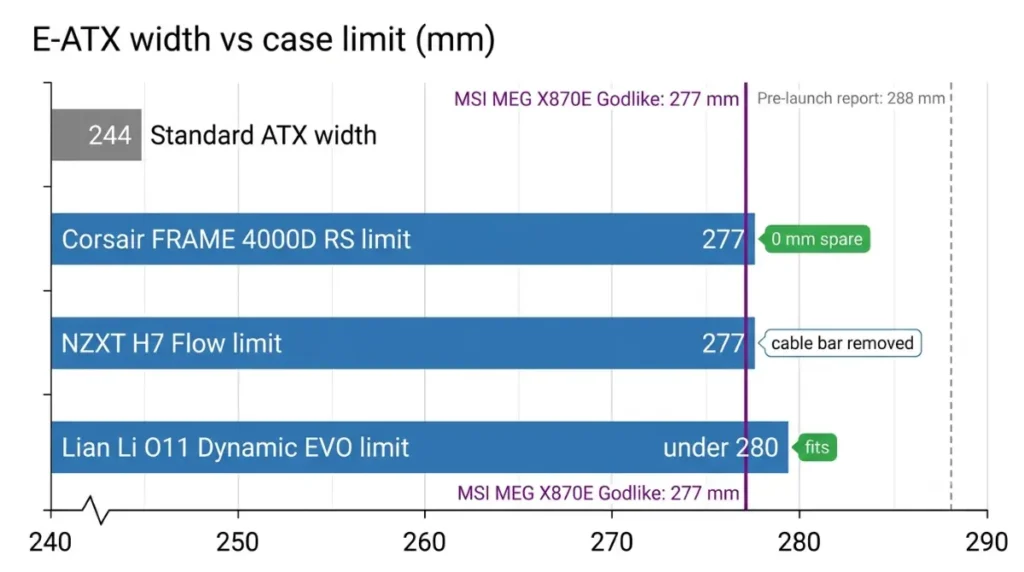
MSI’s MEG X870E Godlike has two sizes in print. Guru3D’s pre-launch report gave it as 288 × 304.8 mm, and MSI’s own e-shop lists 304.8 × 277 mm. Go by the board maker’s figure. The two numbers are 11 mm apart, which is more than the spare room in any of the three cases below.
E-ATX has no fixed size. Thermaltake’s support team says it can’t promise E-ATX fit because most of these boards aren’t standardized, and it sends buyers to the measurements listed for each case. The dimension that grows is the one ATX caps at 244 mm. Case makers usually call it width.
| Case | E-ATX limit as stated | Condition | MEG X870E Godlike (277 mm) |
|---|---|---|---|
| Corsair FRAME 4000D RS | 305 × 277 mm (12 × 10.9 in) | None listed | Fits, 0 mm spare |
| NZXT H7 Flow | 277 mm (10.9 in) wide | Remove the included cable bar | Fits, 0 mm spare |
| Lian Li O11 Dynamic EVO | Under 280 mm (11.0 in) wide | None listed | Fits under the limit |
Sources: Corsair FRAME 4000D RS; NZXT H7 Flow E-ATX support; Lian Li O11 Dynamic EVO; MSI e-shop, above.
Two of the three cases stop exactly at the Godlike’s width. The H7 Flow only gets there once its cable bar is out.
Before you buy: if a case lists E-ATX with no width in millimeters, ask the case maker for that figure and compare it with the second dimension on your board’s specifications.
Back-connect boards need a tray cut for them
Fractal Design’s support team states that boards with their power connectors on the back fit only cases built for rear-connector boards, even though those boards are sold as ATX. Fractal’s list names the North XL RC, Epoch XL, North XL Momentum Edition and Pop 2 Vision. The standard North XL and Pop Air trays have no cutouts for these boards.
The three brands don’t share one connector layout. ASUS calls its boards BTF, MSI uses Project Zero and GIGABYTE uses Project Stealth. Each places its connectors slightly differently (Corsair), so a case cut for one standard can miss another. Corsair validates its reverse-connector cases against all three, and the FRAME 4000D RS lists reverse-connector support in its specifications.
Board size still matters within this group. Corsair’s 6500 series takes ATX reverse-connector boards but not micro-ATX ones. A back-connect micro-ATX board needs a case that names both its standard and its size.
Case spec page: four fields that settle it
Find the case’s model name on its box or your order confirmation. Then open the maker’s product page and read these fields in order:
- Motherboard support, which has to name your board’s form factor.
- Maximum board width in millimeters, for any E-ATX board.
- Expansion slots, the openings at the back that a thick graphics card uses up.
- Reverse-connector support, with your board’s standard named, if its connectors are on the back.
For the board’s side of the comparison, take the model name printed on the board or its box to the board maker’s site. The form factor line there gives both dimensions. Slot openings run short fastest on micro-ATX when the card sits in a lower slot, and how a graphics card sits around the x16 slot works through that case.
Other questions about case sizes
Is a mid-tower the same as an ATX case?
No. Mid-tower describes the outside size of the case, and the support line says which boards fit inside. Corsair sells the FRAME 4000D RS as a mid-tower, and it lists E-ATX boards up to 305 × 277 mm.
Does a smaller motherboard mean fewer slots?
Yes. Intel’s ATX specification allows up to seven expansion slots on ATX and four on micro-ATX. For what a Mini-ITX board gives up in slots, memory and M.2 drives, see Mini-ITX compatibility limits.
Then check cooler height and card length
Once the board fits, the next two figures are on the same product page. The FRAME 4000D RS lists 170 mm (6.7 in) for CPU coolers and 430 mm (16.9 in) for graphics cards. Check your cooler against the first figure with CPU cooler socket compatibility and case height, and your card against the second with whether your GPU will fit your case.
Found this helpful? See more of our guides on Google.
Want to see our guides first on Google?