Steam Machine Power Consumption and a Simple Yearly Cost Check
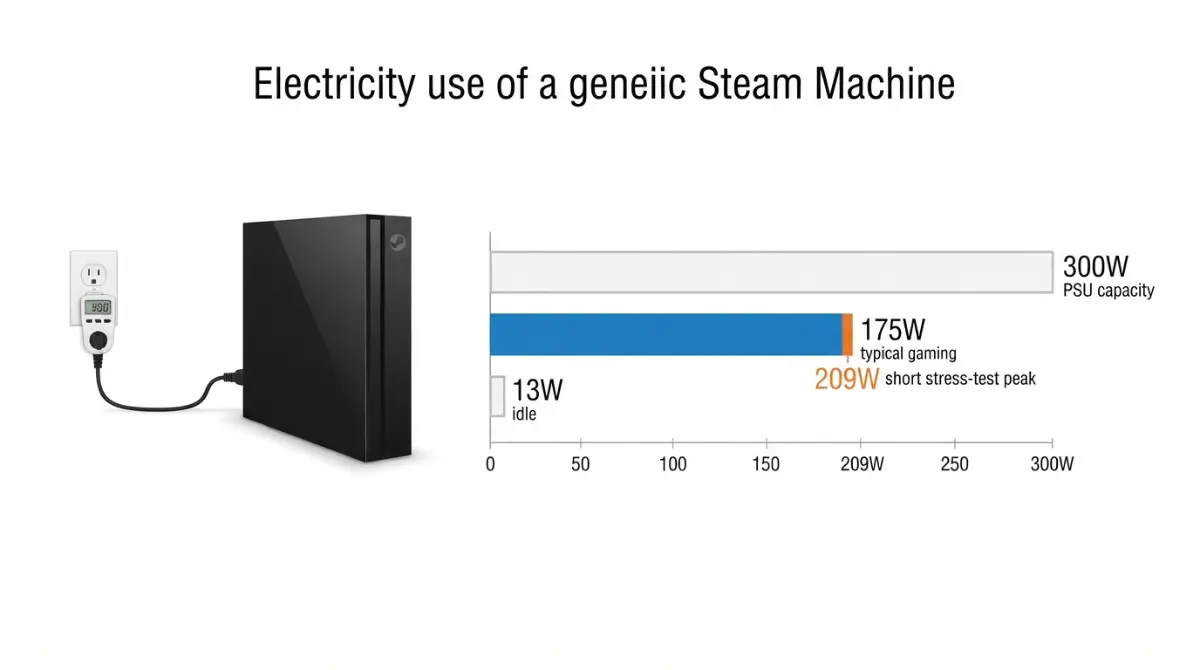
Table of Contents
The numbers in one line
Reviewers logged Steam Machine power draw at 13–17W idle, about 173–190W in heavy games, and 1W or less in standby. These are wall power readings, meaning total system draw at the outlet. The 300W on the spec sheet is capacity, not draw.
This guide extends the Steam Machine specs, upgrades, and limits pillar’s power row into running cost.
Where to jump
Budgeting? Cost table. High rates? Rate table. Meter off?
Is the Steam Machine’s 300W power supply what it draws?
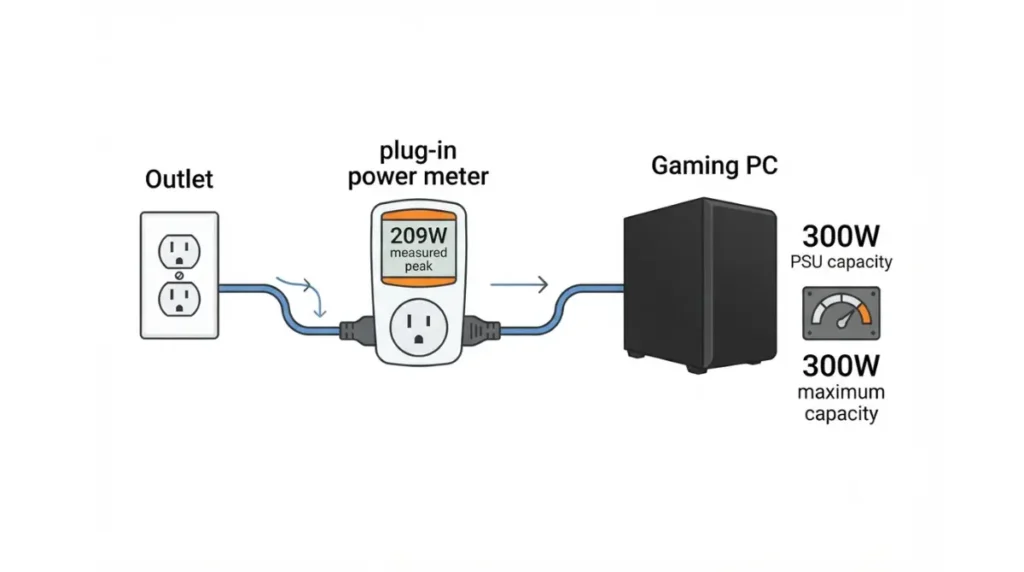
300W is capacity, not consumption
The 300W internal power supply sets a ceiling. The highest wall reading logged was 209W, within capacity per GamersNexus. See Steam Machine PSU wattage.
📊 Spec Check: Tom’s Hardware’s spec table lists 300W, 110–240V, 30W CPU TDP and 110W GPU TDP.
What the 30W CPU and 110W GPU limits mean
TDP (thermal design power) is a rated heat figure, not a wall reading. GamersNexus says Valve limits it “pretty hard” for power and thermal reasons.
🔍 Why It Works: Rated: 30W + 110W = 140W. Wall readings add the rest of the system and conversion losses, so they land above 140W and below 300W.
Can you change the power limit?
No. GamersNexus found no TDP or PPT bypasses; limited settings live in the OS.
How many watts does the Steam Machine use at idle and gaming?
Heavy gaming has been logged at about 173–190W at the wall, idle at 13–17W, and standby at 1W or less.
| Condition | Wall draw | Source and test |
|---|---|---|
| Standby | 1W or less | GamersNexus; always on unless unplugged |
| Idle | 13W | GamersNexus |
| Idle | 15–17W | Digital Foundry; menus reach about 50W |
| Gaming | 173–176W | GamersNexus, Black Myth: Wukong loop |
| Gaming | 176W average (157–185W) | LTT Labs, DOOM: The Dark Ages, 2160p Low |
| Gaming | 180–190W | Digital Foundry, Crimson Desert |
| Stress test | 209W, then 192W | GamersNexus, Blender plus FurMark |
Source: wall readings, GamersNexus, LTT Labs, Digital Foundry launch reviews, June 2026.
Idle and standby draw
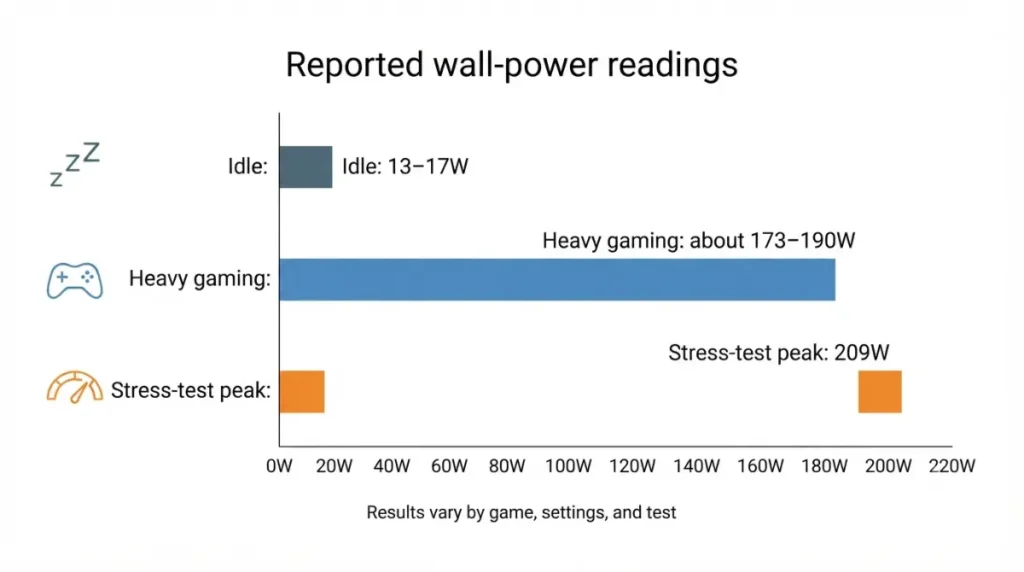
Standby is 1W or less per GamersNexus, citing the manual.
Gaming draw by workload
Draw follows game, settings and resolution.
The worst-case stress test
GamersNexus attributes the drop mostly to CPU limits; it is one test.
How much does it cost to run a Steam Machine per year?
At the U.S. 2026 average of 18.2¢/kWh, three gaming hours a day, one idle hour and standby costs about $37 a year (estimate).
The formula
Annual cost = watts × hours a day × 365 ÷ 1,000 × your rate per kilowatt-hour (kWh). At 175W, a gaming hour costs about 3.2¢ (estimate).
Three usage profiles
| Profile (gaming / idle / standby hours) | kWh a year | Cost a year |
|---|---|---|
| Light (1 / 1 / 22) | 76.7 | $13.95 |
| Everyday (3 / 1 / 20) | 203.7 | $37.07 |
| Heavy (6 / 2 / 16) | 398.6 | $72.54 |
Source: estimates at 175W gaming, 13W idle, 1W standby and 18.2¢/kWh, the EIA projected 2026 U.S. residential average (October 2026). Hours are examples.
What an always-on idle costs
Idle all year costs about $20.73 at 13W or $27.10 at 17W; standby alone, $1.59 (estimates).
Does your state’s electricity rate change the cost?
Yes. Cost scales directly with your rate.
Rate range across U.S. states
EIA’s state table lists each state’s residential price. These rows use example rates, not state averages, on the Everyday profile.
| Example rate | Cost a year | Key detail |
|---|---|---|
| 12¢/kWh | $24.44 | Low example |
| 18.2¢/kWh | $37.07 | EIA U.S. average |
| 25¢/kWh | $50.92 | Mid example |
| 35¢/kWh | $71.28 | High example |
| 45¢/kWh | $91.65 | Very high |
Source: estimates; 18.2¢ from the EIA (October 2026), other rates illustrative.
Using your own rate
Multiply 203.67 kWh by your rate, in any country.
How does Steam Machine power use compare with a DIY build?
Power ratings side by side
| Part | Steam Machine | DIY reference |
|---|---|---|
| CPU | 30W TDP | Ryzen 5 7400F, 65W |
| GPU | 110W TDP | RX 7600, 165W |
| Rated total | 140W | 230W |
Source: Valve figures via Tom’s Hardware and GamersNexus; AMD spec pages. Ratings, not wall draw.
DIY wall draw depends on the parts and isn’t sourced here. The build-your-own Steam Machine parts list shows the reference.
What lower power costs in performance
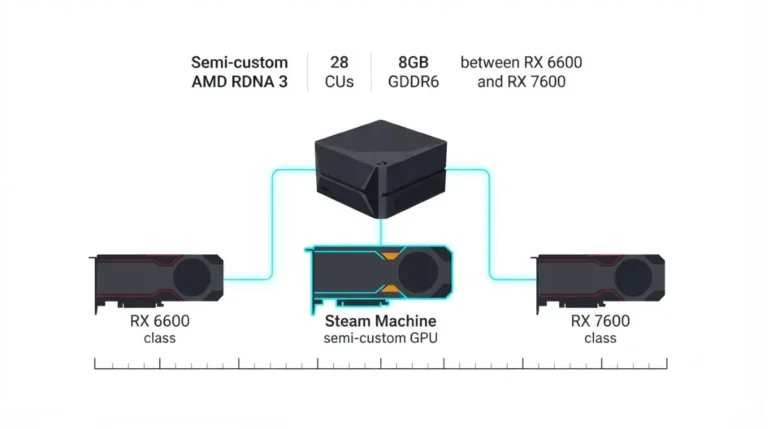
GamersNexus puts the GPU closest to the RX 6600; Tom’s Hardware places it between the RX 6600 and RX 7600. Choose by running cost, performance per dollar, and size.
Why does my wall meter show a different number?
Game and settings
Readings follow the workload. GamersNexus’s loop dipped to about 50W between runs, and LTT Labs ran DOOM at 2160p Low against a 1080p default cap.
⚠️ Watch Out: Overlay tools can report GPU-only power, as LTT Labs’s light-load chart did. A wall meter reads the whole system.
Peak versus average
Cost follows the average, but a plug-in meter shows peaks; LTT Labs’s DOOM run swung 157–185W. If a reading is far outside the published range, contact Valve support.
Steam Machine power consumption questions, answered
1. What is idle power consumption?
Steam Machine power consumption at idle is 13W per GamersNexus and 15–17W per Digital Foundry, measured at the wall.
2. How much does it use gaming?
Steam Machine power consumption in heavy games is about 173–190W at the wall across three reviewers.
3. What is the peak draw?
Steam Machine power consumption peaked at 209W, then 192W, in GamersNexus’s Blender and FurMark stress test.
4. Does standby use power?
Steam Machine power consumption in standby is 1W or less per GamersNexus; it stays on unless unplugged.
5. What power supply does it have?
The Steam Machine has a 300W internal power supply rated 110–240V, per Tom’s Hardware’s spec table.
6. Does 300W mean it draws 300W?
No. Steam Machine power consumption peaked at 209W in GamersNexus’s stress test, inside the 300W capacity.
7. What does it cost per year?
Steam Machine power consumption costs about $37 a year at 18.2¢/kWh, for three gaming hours and one idle hour daily (estimate).
8. What does an hour of gaming cost?
An hour of gaming costs about 3.2¢ at 175W and 18.2¢/kWh, an estimate from published Steam Machine power consumption.
9. Does my rate change the cost?
Yes. Steam Machine power consumption cost scales with rate: about $24 a year at 12¢/kWh, $92 at 45¢ (estimates).
10. Can I change the power limit?
No. GamersNexus found no TDP or PPT bypasses, so Steam Machine power consumption stays within Valve’s limits.
Your next step
Run the formula once with your hours and the cents-per-kWh line on your bill. Published readings put Steam Machine power consumption at 13W idle, 173–190W gaming and 1W or less in standby. Running cost is one input to the console choice: see Steam Machine vs PS5 Pro price and specs. Figures are published readings and estimates, not our measurements.